
Report 2026
by Bronwen Buckeridge and Neil Chapman, participants
Artist. Teacher. Student. Artist. Student. Teacher. Artist
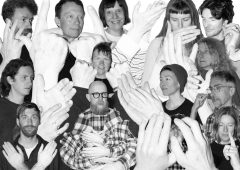
A gathering of twelve artists for the eighth Cornwall Workshop, which was led by Ane Hjort Guttu and Adam Chodzko, took place on the Lizard Peninsula over seven days in early March 2026. All the participants have connections to the South West and most have experience of teaching in an art school.
The week included sessions inspired by Ane’s research around Paulo Freire’s idea of the student-teacher and the teacher-student, as well as workshops connected to Adam’s investigations into dreams and dream sharing. The group had been asked to bring examples of work to present and share in an exchange of one-to-one tutorials.
—–
As they make their way down the narrow lane towards Kestle Barton, the handful of cars and longer shape of the minibus are reflected in the eye of one of the many buzzards that pass over the buildings and fields around Manaccan.
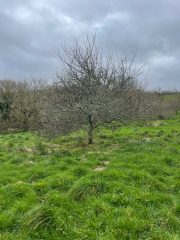
On the ground it is chilly. The apple trees just hinting at white. The cowslip meadow stubbornly green.
Clusters of activity are visible from the air: figures hurrying from the outer buildings to gather in the main barn or moving more slowly as a single unit towards the woods or in the direction of the apple store. Untidier, more sprawling shapes are seen on days when it is warmer, and the workshop spreads outside to the tables in the garden.
In the early mornings, high above the site, drifting birds spot one or two figures heading out on foot. They idly track their progress along the straight line of the lane, forking northeast as their target heads downhill through the woods for a swim at high tide.
The same sharp eyes observe the winding line of human heads slow-walking in the orchard for the dream workshop Adam sets up midweek. The heads turn and move in the other direction.
Other days it is quiet. Hunting elsewhere, they likely miss the white shape of the bus making its way back up the lane for a trip to the earth station at Goonhilly, or to CAST where Ane shows one of her films.
Who knows if the headlights pick out the nests of smaller birds in the hedgerows as the bus heads back. Do they open their eyes into the glare?
Most nights the lane is left to itself. Light leaks out yellow from the barn as dinner is served. The buzzards safely roost in the taller trees nearby.
What follows is a conversation between workshop participants Neil Chapman and Bronwen Buckeridge sharing their recollections of that week in March.
NC: Let’s talk a bit about the tutorials.
BB: Okay. For most of the group it would probably have been a long time since they were on the receiving end of a tutorial. Who were you with?
NC: I was paired with Laura, which was great but I remember in the feedback afterwards confessing I’d spoken in an unbroken monologue for three quarters of an hour. I’m not at all sure that’s actually what happened. But I did speak a lot, and felt a bit guilty when we were discussing it later.
BB: [laughs] Oh yes that’s right. We all met afterwards for a group sharing session. It was nerve-wracking wasn’t it, finding out how you were as a tutee.
NC: It was certainly unusual. Tutorials tend not to be interrogated after the event. I mean, maybe you write some notes, or maybe the student writes a digest of what happened, but it’s not public information.
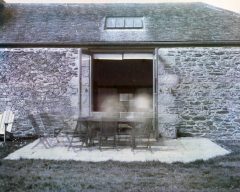
William Arnold’s long exposure of the group working in the garden. Paper negative shot on a 5 x 4 “ field camera.
BB: I seem to have no recollection of how I was as a tutee or rather how it was reported back. Maybe I panicked and didn’t listen… Were you aware you were speaking in a monologue at the time?
NC: Yes. I gave myself that license. It was useful to make a story of my work for someone who didn’t know anything about what I am working on. But of course, it is always flattering to have someone who’s prepared to listen.
BB: I haven’t thought of it that way, but yes…
NC: And in that sense I do feel awkward about how it went. Did you feel you got something out of the exercise?
BB: I did. Garry was my tutor. He works quite a bit with documentary photography and he had shown us his images of ‘Rockall’ in the Atlantic the day before. I was struck by the strangeness of seeing this rock. It’s such a familiar name and somehow I’ve never stopped to wonder what ‘Rockall’ really is. Sitting down with him I was suddenly very aware of my own documentation, and maybe a bit self-conscious. It jumped me slightly outside of the usual way I talk about my work, which made me look at it from a different angle. It was interesting, and also a bit unsettling…
NC: What about when you had the tutoring role?
BB: I was with Mark. I felt quite a responsibility as his tutor. There’s always the need to be thoughtful, responsive and stay in that role isn’t there. Most of all to pay attention. I wanted it to be useful.
NC: You surely feel that with your own current students?
BB: I do, but I think it was heightened in this situation because you knew you were going to be spending a whole week in each other’s company. There’s a vulnerability too in giving a tutorial to someone who is experienced at it themselves.
NC: Was it a good pairing, do you think?
BB: I think (hope) so, but I’m certain you could be paired with anyone and it has the potential to be productive. I’m very resistant to the idea that expertise is the only thing that counts. There’s always something of value that someone from a different context or with a different level of experience can offer to your work.
NC: That might even have been one of the workshop’s principles, the idea that if both student and teacher are committed, and if they are sensitive listeners, then the teaching and the learning will happen, even if it’s not always predictable what, precisely, is being taught and learned. It’s something along those lines that Jacques Rancière describes in The Ignorant Schoolmaster. That book, cited in the preparatory materials for the workshop, never really got discussed properly.
BB: It didn’t but I like the practice of openness and exchange in that approach. I wonder sometimes whether the discussions we have in tutorials are also discussions with ourselves. The issues we uncover are usually something that we identify from our own set of concerns. A shared space if you like.
NC: I think that’s true. It seems inevitable; preferable too if the alternative is discussing issues with no stakes. During the tutorial phase of the workshop maybe the critical discussion was hampered by us not knowing each other sufficiently well. With more time, the conversations could have got on to the trickier points.
BB: That sounds very likely. Who did you give a tutorial to?
NC: I worked with Holly. She presented elements from her PhD thesis. And she was very generous, saying she got something out of the discussion. For my own part, I would have liked to find a different position, less that of a supervisor and more, I don’t know what, maybe a non-professional observer, to escape from my own habits. Maybe I wasn’t sufficiently prepared. It would probably have required a prior discussion and agreement.
Who would you have picked as your ideal tutor?
BB: I think I’d have been happy to work with anyone. Maybe as a surprise. I quite enjoy being thrown into a new situation.
NC: If you’re confident in your work these scenarios have more potential.
BB: That’s the purpose isn’t it, to really go there. Over the years some of the best tutorials have been the difficult ones. They’ve been quite troubling.
NC: You mean tutorials you’ve received?
BB: Yes. I still go back to them sometimes. They have made me think into some difficult spaces. I’m not sure I exactly enjoyed them at the time, but they pushed me. One of my old tutors used to send back a piece of writing in response to our tutorials. It was like somebody putting into words the thing you were still forming in your head, and having it held still so you could take a proper look at it.
NC: I think I got that sort of thing during my PhD research. I was exposed on a few occasions and think back on it as a kind of exquisite pain/pleasure experience.
BB: I suspect a one-to-one tutorial can sometimes feel a bit like a session in therapy where you come to meet some unexpected, less pleasant version of yourself. I mean both disciplines use structured conversation and strict timings, although with a tutorial the encounter is with an artwork rather than the self, so the intention at the outset and the focus are very different.
Somehow though as part of the tutorial process the act of allowing another person into your work almost inevitably produces a new version of that work. As a tutee you may or may not be ready for that. I think that is why it can be painful at times.
NC: And likewise, when it’s pleasurable, or when it’s a mixture of pain and pleasure, that can be because of a residual stuckness that’s banished.
I suspect most of us didn’t get near that in the workshop.
BB: Maybe not, but the idea of different perspectives and ways of looking did come up as part of the observed tutorial that Ane led.
NC: Was that on the Tuesday morning?
BB: I think so. It was quite a particular set up wasn’t it. We all squeezed into the room Ben was staying in. He had suspended some of his paintings from the beams, laid others out on the floor and over the back of chairs. It was a full hour. Ben was the tutee, Mark was the tutor and Ane gave the rest of us tasks as observers.
NC: There were a couple of us drawing.
BB: Did Ane suggest what you should draw?
NC: No, the instruction was left ambiguous. But I interpreted it as about recording the changing body postures of tutor and tutee.
BB: How was that?
NC: I was very much engrossed with the practical difficulties. And those were real. It’s not easy drawing figures in movement. But with hindsight I can see I was using that focus as a way of shielding myself from another difficulty: the embarrassment of being present during an exchange that would usually be conducted in private. At the time, I was probably tending to assume the embarrassment as my own shortcoming. But of course, the exercise of the ‘public one-to-one tutorial’ anticipated that difficulty. In many ways it was the subject. How about you? Can you remember the different delegated tasks? I think there were ten or twelve.
BB: Okay so I was sitting on the bed next to Laura. I could hear her pencil moving and pastels sticking and lifting the paper. Robin was drawing too, and Joe. I think Joe was concentrating on the moments Mark and Ben touched or moved the work. Josie was on silences. Or maybe she had been tasked with recording the number of questions asked. William made a graph. There were two lines, a kind of cardiogram with points plotted along the scale; one for Ben, one for Mark. I found it quite beautiful.
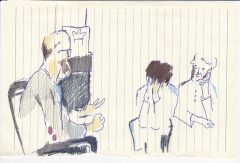
Robin Phoenix Whitehouse’s sketch of the observed tutorial in progress.
As an activity though, it was certainly awkward, more so perhaps because it was in such an intimate setting. But I also loved it, maybe precisely because of the awkwardness. I was fascinated by the liveness, and sense of improvised theatre. In my own work I’m often playing with the application of rules or the production of data through idiosyncratic or absurd means, so it spoke directly to things I am already interested in.
I found the tense calm of everyone taken up with their task quite compelling.
NC: What was your task?
BB: I had the job of writing creatively. I was utterly lost in that, hyper-present in a way, but because I was so focused on what I was doing I was also aware of being strangely ‘not there’, at least not in the role of a critical observer. Writing in real time was more like using words to keep pace with the rise and fall of voices through the hour. I found myself drifting inside the paintings and bringing the birds and flowers out into the room.
It might have seemed to Ben and Mark that they were being closely watched, but I had more of a sense of us all being part of the same activity, an extension of whatever was generating from the central space. We were all ‘in it’ in some way, rather than looking in from the outside.
NC: The sessions we did with Adam, based on the work he’s doing with dreams, were very different.
BB: They were, but you could think of the tutorial as a dream space in its own way. It operates as a kind of shadow event where you start to bring the work into language, and move it around to test for future shapes. It can feel vulnerable too, sharing an internal vision of something you are working on with another person. Especially if it is the first time you have spoken about it.
NC: Am I remembering correctly that it was the following morning when we were invited by Adam to take part in some actual dream-sharing, when we took turns telling our dreams, concluding by saying: “And then I woke up”?
BB: That’s right, and then we went out into the orchard where Adam asked us to form a long snaking line through the trees and move really slowly.
NC: Really slowly!
BB: We were spaced about 30 feet apart from each other. And one by one we turned around, walked to the person behind us and gave them a dream object.
NC: Yes, without saying what it was.
BB: I think the first time we whispered, and the second time we tried to do it telepathically. I had Anna in front of me, and she gave me a giraffe on roller skates. It was such a vivid image. I can picture it now with blue spots and its legs slightly splayed. It felt strange to let something so deeply into my head which didn’t belong there, or seem to fit with the usual bank of images I carry around.
NC: And what did you give?
BB: I had Ane behind me, and as I turned around a field mouse darted out and ran over her shoe.
NC: Did she see that?
BB: She did, so I discarded my first idea and gave her the mouse in dream form.
I enjoyed that moment of pause and being so still. There was nothing to do apart from look very closely at what was around us.
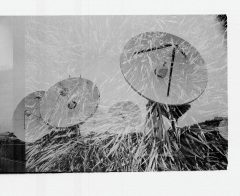
Holly Antrum’s 35 mm scan of the dream workshop double exposed with a shot from the outing to the earth station at Goonhilly. Made with an Olympus OM-1.
BB: We were given some set texts in advance, though we didn’t talk about them very much in the week. Did you read them?
NC: Yes. The piece by Moten and Harney was particularly interesting, and indicative of the workshop’s themes.
BB: In what way?
NC: It addresses directly the predicaments faced by those who are critics of contemporary Higher Education but who are obliged for one reason or another to continue working in the university environment. The idea the authors explore is that there are spaces within the institution — what they refer to as a subterrain or ‘undercommons’ — in which a kind of clandestine work can take place. As the piece progresses it’s clear they’re aware of the complex issues thrown up by the idea.
BB: That reminds me of the work Ane showed during her talk at Falmouth University on the Tuesday evening where a group of students constructed a hidden kitchen within the newly built walls of the art school. It folds away perfectly when it’s not in use.
NC: Oh yes, Manifesto (2020). There’s an interesting tension between that work and Moten/Harney’s remarks. In their essay it’s not at all clear that a subversive work can take place in the contemporary institution without a risk, always, that it will become the opposite, which is to say it becomes another resource sustaining the institution.
BB: You mean the institutional version of student life and the grassroots activities which take place after hours and behind walls are co-dependent?
NC: Yes, in a sense. When students embrace their identity as such they operate on the side of the institution. When they flout the rules, they pose a critical threat. But when the dissent remains under the radar it becomes a form of support again. Co-dependency may not be quite the right term. It implies that both parties are fully conscious of the other. That’s not quite how it is in the university. The students in Ane’s film got round the regulations. They built their own kitchen, hidden behind the wall. It was direct action, it was a kind of criticism, but more towards making the place habitable for them than about forcing systemic change. It is a shame we didn’t find time for a discussion of that text at least. Actually, Josie and I did find a moment, but we didn’t get a chance to report back.
BB: The ideas did come up though in different ways. There was the work Robin presented from his final show at The Hague. You know the piece where he was pretending to work on a series of paintings in his studio but out of hours he was busy with the real work where he was excavating smashed up sculptures from the former art academy which were hidden in the basement of the building.
We also took on those sorts of roles ourselves at some point, mostly in the last couple of days when the idea of making a publication together came up and we’d been allocated various tasks to make it happen.
NC: Where was the subterrain there?
BB: Well there was the official publication HQ in the apple store. We had all the texts pasted around the walls and laid out on a long table. Some people were writing, some were making images. Quite a few people were trying to get the inkjet printer to co-operate. Then there was a smaller contingent who decided to break away and do their own thing.
NC: What? Did that actually happen?
BB: [laughs] It really did. I was working on a text with Ben, and I’d wandered off to collect my thoughts. I headed towards Paul Chaney’s wooden pavilion at the far end of the orchard. Inside there was a small group sitting on the straw bales who were busy with an alternative edit; a manifesto of sorts, maybe a different front cover, I’m not sure what else. Anna and I promptly hatched a third plan to head to the pub through the woods. William joined us. We didn’t exactly spread the word, but by the time we managed to get ready and find our boots, almost everyone was in. It was a mass exodus.
NC: I have a feeling that there probably wasn’t as much of that kind of ‘escape’ during the workshop as there would have been if we’d been there for longer.
BB: It’s interesting you think it was just a question of time.
NC: I think there is a valuable dynamic that can emerge in this kind of collective work. The conversation begins cautiously. Everyone’s working it out. And then it’s as if a kind of phase shift takes place. Without warning the principles are being subjected to an audacious, critical playfulness. Maybe you were witnessing the beginnings of that kind of thing in the pavilion. I think the organisers and planners would have been up for it. Indeed, there is a way of thinking about the workshop as attempting precisely to facilitate such transformations.
BB: You might well be right. In any case it turned into a wonderful evening. There was a blaze of orange sun dropping through the trees. One group left the pub before dusk. Another lot were picked up by car, and the rest of us made our way back in the dark through the woods. Then there was the final dinner. Do you remember what it was?
NC: I only remember it being copious and delicious.
BB: It had got warmer during the week and we left the doors open. There was a lot of laughter that night.
Participants
Holly Antrum, William Arnold, Anna Boland, Bronwen Buckeridge, Neil Chapman, Josie Cockram, Laura Hopes, Joe Lyward, Mark Leahy, Garry Loughlin, Ben Sanderson, and Robin Phoenix Whitehouse.
Cornwall Workshop photo collage 26. Garry Loughlin
The apple orchard, early spring. Bronwen Buckeridge